You can leave luggage in a Japanese coin locker overnight when that locker’s rules allow it. Before you pay, check three separate things: when another daily charge starts, the last permitted collection date, and when you can physically reach the locker. An overnight stay does not automatically buy you 24 hours.
For example, JR East Smart Logistics’ general locker FAQ uses a 02:00 daily rollover, while Osaka Monorail and Hiroshima Airport publish midnight rules. The examples below show how to turn those conditions into a collection plan. They are operator-specific rules, not one policy for every locker in Japan.
Official information checked: 12 November 2026. All times are Japan Standard Time. This is a guide based on published conditions, not an on-site locker test.
- Using a Coin Locker Overnight in Japan: Fees and Day Counting
- Using a Coin Locker Overnight in Japan: Collection Limits and Backup Plans
- Read how the maximum storage period is counted
- Choose a storage arrangement that covers your whole trip
- Understand what happens after the locker limit
- If your return is delayed, contact the operator early
- Keep your collection details somewhere accessible
- Ask about the exact collection time, not just “overnight”
- Final checklist for leaving luggage in a Japanese coin locker overnight
Using a Coin Locker Overnight in Japan: Fees and Day Counting
- Identify the operator before choosing an overnight locker
- Compare these published overnight locker rules
- Count daily billing periods instead of assuming 24 hours
- Work through a simple overnight fee example
- Check whether you can reach the locker at night
Identify the operator before choosing an overnight locker
Start with the company name and terms displayed on the locker you intend to use. A station name alone is not enough to identify the service. Record the locker bank’s location and the contact information on its notice before leaving your bag.
Match any online FAQ to that product. For instance, JR East Smart Logistics links to a separate Multi-Ecube FAQ from its general locker FAQ. Do not assume that a rule on one page covers every locker carrying a related brand. If the posted terms and the page you found describe different products, resolve that difference before depositing luggage.
Compare these published overnight locker rules
These three official examples illustrate why the daily rollover and storage limit need separate checks. The Hiroshima example is an airport facility; it does not establish a rule for Hiroshima’s railway stations.
| Operator or facility | New daily charge | Published collection limit | Access information |
|---|---|---|---|
| JR East Smart Logistics, general locker FAQ | 02:00 each day | Three days from the start date | Check the particular location; this FAQ does not specify its access hours |
| Osaka Monorail station lockers | 00:00 each day | Within three days, including the deposit day | First train to last train at the station |
| Hiroshima Airport locker notice (PDF) | 00:00 each day | Collect within 14 days, including the deposit day | 06:00–22:30 |
Read the notice on your actual locker before paying. A rule for one operator should not be carried over to another operator simply because both lockers are in Japan.
Count daily billing periods instead of assuming 24 hours
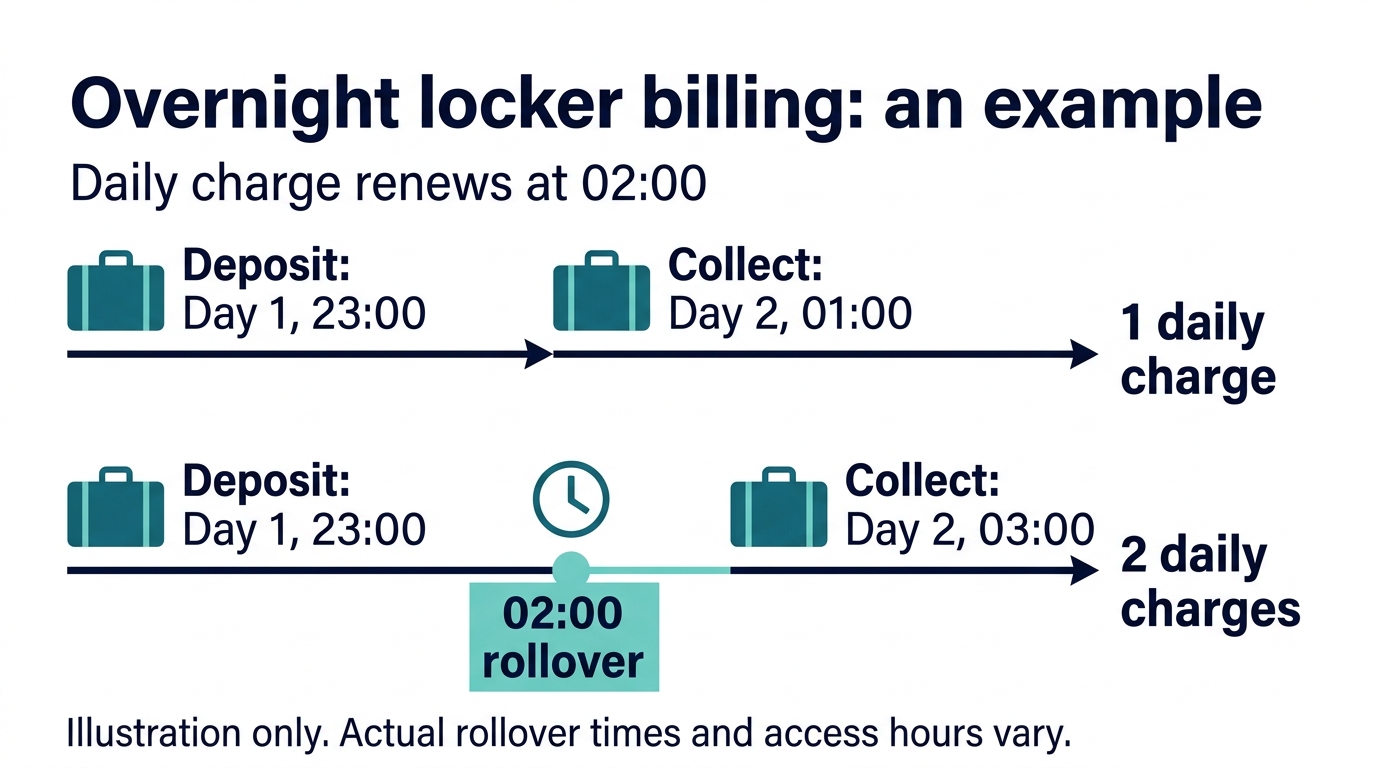
For a daily-rollover tariff, write down your deposit time and intended collection time, then mark each rollover between them. The initial charge covers the first billing period; passing a rollover adds another daily charge under that tariff.
This is different from calculating elapsed hours. A short stay spanning the rollover can cost more than a longer stay entirely within one billing period. If the machine instead displays an hourly or elapsed-time tariff, use that tariff rather than the daily examples here. At exactly the rollover time, use the operator’s displayed calculation; plan to collect with a margin rather than relying on a last-minute boundary.
Work through a simple overnight fee example
Suppose a locker has a fixed daily charge of ¥600 and renews its billing day at 02:00. This is an illustrative price, not a quotation for a particular locker. You deposit the bag at 23:00 on Monday.
| Collection time | Daily charges counted | Illustrative total |
|---|---|---|
| Tuesday, 01:00 | One | ¥600 |
| Tuesday, 03:00 | Two | ¥1,200 |
Under a midnight-rollover tariff, both of those collection times would fall after the first rollover. The comparison explains the billing difference only: it does not promise that a locker area is open at 01:00 or 03:00. Substitute the actual tariff and permitted access times for your chosen location.
Check whether you can reach the locker at night
Permission to store a bag overnight does not necessarily include overnight access. Osaka Monorail explicitly says station interiors cannot be entered outside its locker access hours. Hiroshima Airport likewise publishes a daytime-to-evening access window in its locker notice. A bag may therefore remain stored while collection is unavailable.
Build your plan around the time you need the contents. If you need a bag for an early departure, work backwards from that departure and confirm the earliest available collection time. For a late-night return, confirm the relevant entrance and locker area’s closing time. A timetable, a building’s hours and a particular entrance’s hours answer different questions; check the route you will actually use.
Using a Coin Locker Overnight in Japan: Collection Limits and Backup Plans
- Read how the maximum storage period is counted
- Choose a storage arrangement that covers your whole trip
- Understand what happens after the locker limit
- If your return is delayed, contact the operator early
- Keep your collection details somewhere accessible
- Ask about the exact collection time, not just “overnight”
- Final checklist for leaving luggage in a Japanese coin locker overnight
Read how the maximum storage period is counted
Billing days and the maximum permitted storage period are separate conditions. Paying an additional daily charge does not itself extend a locker’s stated limit.
Where the rule expressly includes the deposit day, mark that date as day one. Under Osaka Monorail’s three-day rule, a Monday deposit means planning collection by Wednesday within station access hours. Do not interpret it as 72 hours starting from whatever time you deposited the bag. Hiroshima Airport’s notice says to collect within 14 days including the first day; use that explicit collection instruction rather than treating its later removal provisions as extra permitted days.
Choose a storage arrangement that covers your whole trip
Before leaving town for several nights, put the deposit date, return date and collection time on the same note. Compare the entire interval with both the storage limit and the access window. A return that is within the date limit can still fail if it is after the facility closes.
If your itinerary does not fit, arrange another storage option before departing. Ask any alternative provider to confirm the full period, bag size, collection hours and total price. A staffed counter or accommodation may be worth asking, but do not treat it as available until that business accepts your request. Keep anything you will need during the trip in a separate bag before storage.
Understand what happens after the locker limit
The published policies do not describe indefinite storage in the original compartment. JR East Smart Logistics says it opens lockers after the permitted period and transfers the contents to designated storage, normally for up to 30 days with daily storage fees. Its FAQ also describes disposal provisions, including for prohibited contents. See the operator’s full conditions for the applicable details.
Osaka Monorail and Hiroshima Airport also describe removal, separate storage charges and eventual disposal in their linked rules. Those recovery arrangements are a consequence of missing collection, not a service to book for a longer trip. Recovery may require contacting staff rather than returning to the original door.
If your return is delayed, contact the operator early
As soon as you know you may miss collection, use the contact details shown for your locker. Give the location, locker number, deposit date and your revised return time. Ask whether the bag remains in the locker, where it can be collected, what identification or collection proof is needed, and what charges apply.
Do not assume that a message automatically extends the rental or guarantees immediate release. Get an actual collection instruction from the responsible operator. If you are travelling onward, resolve where the bag is and when it can be released before buying a tight connection that depends on collecting it.
Keep your collection details somewhere accessible
Save the station or facility name, floor, nearby entrance, locker number and operator contact in a note you can access without opening the stored bag. Keep the key, receipt or other collection credential with you. Avoid sharing a PIN or retrieval code publicly.
It is also sensible to set a reminder before your planned collection time and another before the final permitted date. Use a margin that fits your itinerary. A reminder for the daily rollover helps manage fees; a reminder for the access window helps avoid being unable to reach the bag. They serve different purposes.
Ask about the exact collection time, not just “overnight”
If you cannot confidently interpret the terms, ask a question containing dates and times. You can use this message as a template:
I plan to leave one bag in locker [location/number] at [time] on (deposit date) and collect it at [time] on (collection date). Is that within the permitted storage period? How many daily charges apply, and will this locker area be accessible at my collection time?
This is a sample question, not a confirmation from any operator. Record the answer for your exact locker. If there is no confirmed way to collect at the time you need it, choose another plan before storing the bag.
Final checklist for leaving luggage in a Japanese coin locker overnight
- Match the posted operator and product to the rules you read
- Record the daily rollover time and displayed tariff
- Count billing periods through your intended collection time
- Check the final permitted date, including the first day where specified
- Confirm you can reach that locker area when you return
- Keep collection credentials and the operator’s contact details with you
- Arrange another option if your dates or access needs do not fit

Comments